
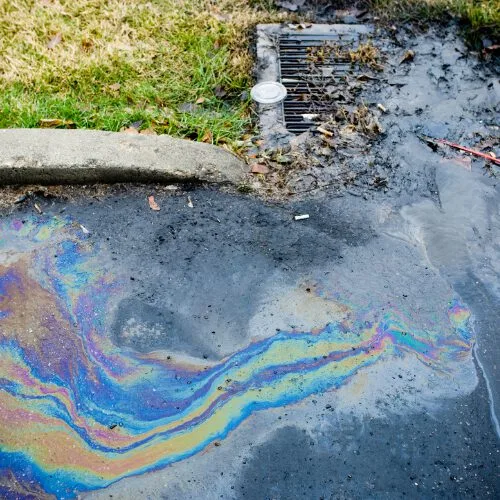
What are oil binders?
Oil absorbents are materials used to absorb and bind spilled oil or other hydrophobic liquids. They are crucial for dealing with environmental pollution and come in various forms, such as Granules, powders and liquids. Their uses range from cleaning up small spills to tackling major oil spills, with the choice of oil absorbent depending on the type of oil, the quantity and the environment.
What types of oil absorbents are there, and what are they made of?
There are two main types of oil binders: adsorbent (granules) and absorbent (liquid binders and mats). Granules are often based on natural substances such as clay, diatomaceous earth or modified polymers, which bind oil to their surface. Liquid oil binders In contrast, these trap the oil within their structure and are often based on biodegradable substances, which makes them particularly environmentally friendly.
How do liquid oil binders differ from granules in terms of their application?
Liquid oil absorbents offer specific advantages over granules: they are easy to use, as they can be sprayed directly onto the oil, and spread quickly across the entire contaminated surface, enabling efficient and rapid absorption. Furthermore, liquid absorbents can reach hard-to-access areas and spaces, making them ideal for complex spill situations. Granules, on the other hand, are better suited to large-scale spills on solid surfaces, but can be less controllable in windy or inclement weather.
Are liquid oil binders better than granules?
Liquid oil absorbents offer a decisive advantage in responding immediately and effectively to oil spills, thanks to their rapid dispersion and ability to reach hard-to-access areas. Granules, on the other hand, are valuable due to their ease of use and suitability for large-scale clean-up operations, particularly when time is less of a critical factor. The choice of the appropriate oil absorbent ultimately depends on the specific spill situation and the prevailing environmental conditions.
How do you dispose of used oil absorbents?
Used oil absorbents should be handled and disposed of in accordance with local environmental guidelines to prevent further environmental impact. An exception to this is liquid oil absorbents, which in certain cases do not need to be disposed of separately as they are biodegradable. Whether this applies in a particular case should be clarified with the relevant authority.