
What should you do if oil has got into the ground?
The first step is to stop any further oil leakage and secure the area. Soil contamination with mineral oil is regulated in Germany by the Federal Soil Protection Act (BBodSchG) and the Federal Soil Protection and Contaminated Sites Ordinance (BBodSchV). You should therefore notify the relevant environmental or soil protection authority – they will determine which remediation method is appropriate in each individual case.
What options are there for remediating oil-contaminated soil?
Essentially, there are two ways:
- Soil replacement: The contaminated soil is excavated, removed and disposed of, after which new soil is brought in.
- On-site biological remediation: The microorganisms present in the soil break down the hydrocarbons. A nutrient concentrate significantly accelerates this natural process.
Biological remediation eliminates the need to remove and dispose of the soil. The competent authority decides which method is appropriate in each individual case.
How does biological soil remediation using FMO soil remediation work?
FMO Soil Remediation is a liquid, water-dilutable concentrate of active ingredients based on biosurfactants and organic raw materials. It serves as a source of nutrients for the microorganisms present in the soil. These multiply rapidly and break down hydrocarbons significantly faster than they would without this support. FMO Soil Remediation is effective for mineral oils in the C11 to C40 range. As the Biological surfactants and the microbial degradation We explain how this works in detail in separate articles.
How quickly does biological remediation take effect?
In laboratory tests using contaminated soil (Münster, 1998), the hydrocarbon concentration fell by 80 to 95 % within 35 days. A measurable reduction in the smell of oil is evident as early as the first day after application. How long this takes in individual cases depends on the type and quantity of oil, soil moisture and temperature.
How is FMO soil remediation applied?
The quantity depends on the concentration of mineral oil hydrocarbons (MKW) in the soil:
| Step | Calculation |
|---|---|
| Basic formula | kg MKW per tonne of soil × 0.2 = litres of FMO soil remediation per tonne of soil |
| Example | 5 kg MKW per tonne of soil × 0.2 = 1 litre of FMO soil remediation per tonne of soil |
| Concentration of the solution | 2 to 10 % depending on the soil’s absorption capacity; usually 5 % |
| Repetition | several doses; the amount is roughly halved each time, depending on the results of the breakdown |
After your purchase, you will receive detailed instructions for use, including mixing tables and practical advice.
What conditions are required for decomposition in the soil?
- Soil moisture: ideally 60 to 80 % of the soil’s maximum absorption capacity
- Temperature: at least 8 °C at the time of application
- Repeat: The process is repeated until the hydrocarbon content returns to its natural level
Is FMO soil remediation classified as a hazardous substance?
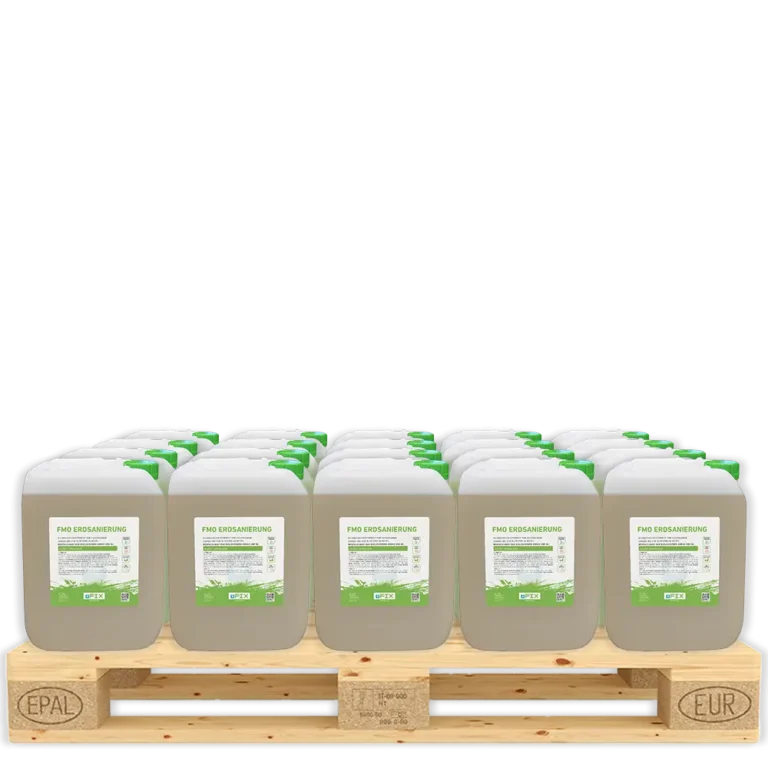
No. FMO Soil Remediation is not classified as a hazardous substance; the working solution is classified as Water Hazard Class 0. The ingredients are biodegradable, non-bioaccumulative and non-persistent; protective clothing is not required for use. FMO Soil Remediation is available in 10-litre canisters (minimum order 20 canisters); other pack sizes are available on request.