
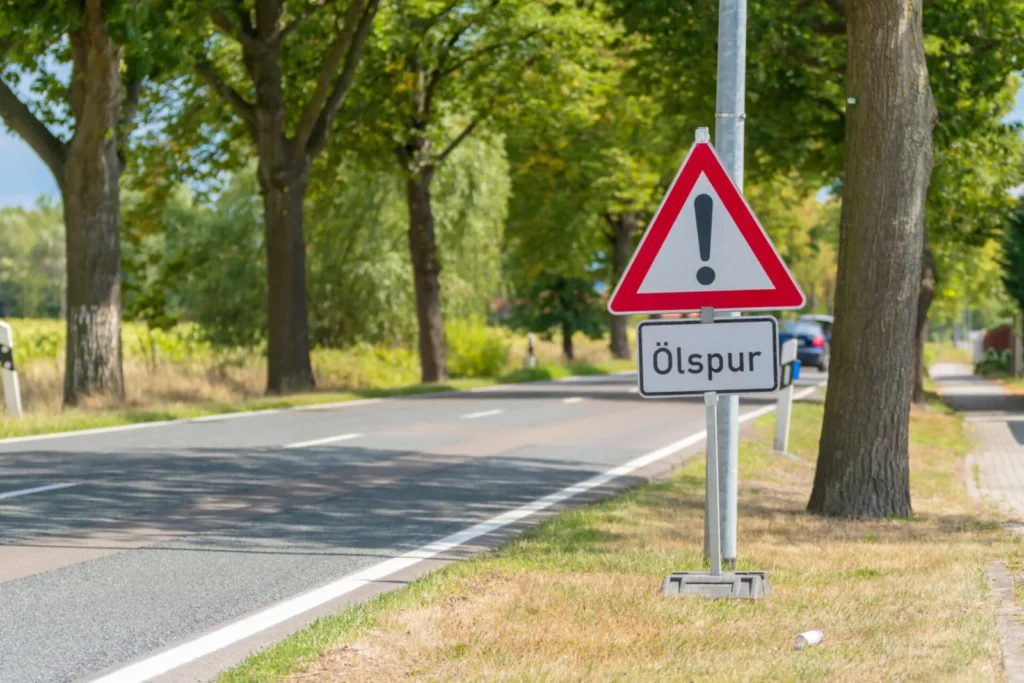
What should I do if I spot an oil spill?
Firstly, you should inform the relevant authorities, such as the police or the local authority’s public order department. They can put traffic safety measures in place and arrange for the area to be cleaned. Specialist companies use special Cleaning vehicles, in order to safely absorb and remove the oil. It is important for members of the public to avoid coming into contact with the oil spill and not to attempt to clean it up themselves, as this may lead to further contamination.
How can I correctly identify oil stains?
You can usually recognise oil spills by dark, shiny patches or rainbow-coloured streaks on the ground. They may be visible on various surfaces such as tarmac, concrete or even in water. When wet, oil stains become particularly slippery and dangerous – also watch out for the characteristic smell of engine oil or diesel. Keep your distance, cordon off the area and notify the relevant authorities as soon as possible.
How does an oil slick form?
An oil spill occurs when liquid oil products leak from vehicles or machinery onto roads or other surfaces – for example, due to faulty engines, gearboxes or hydraulic systems. Oil spills are not only harmful to the environment, but also pose a risk to road safety, as they increase the risk of skidding.
Who is liable for damage caused by oil spills?
Liability for damage caused by oil spills generally lies with the person or company whose vehicle leaked the oil or fuel. Under the ‘polluter pays’ principle, they must cover the clean-up costs and any environmental damage. In practice, however, it is often difficult to identify the party responsible – which is why local authorities or road maintenance bodies initially carry out the clean-up to avert any danger. The costs can subsequently be recovered from the party responsible, provided they can be identified.
How do I report an oil spill?
To report an oil spill, please contact your local police or your town’s public order office immediately. Alternatively, you can contact the fire brigade on the emergency number 112, particularly if the oil poses an immediate danger. Please provide the exact location and the size of the oil spill to enable a swift and effective response.
How do you use liquid oil binders safely?
When using liquid oil binders It is important to read the manufacturer’s safety data sheets and instructions carefully. The absorbent is usually applied directly to the oil spill and must be left to work for a certain period of time in order to absorb the oil completely. Once the application time has elapsed, the bound oil can be safely disposed of. Personal protective equipment should be worn during application to prevent skin contact and the inhalation of vapours.
What are the advantages of liquid oil binders compared with other methods?
Liquid oil binders offer several advantages over traditional methods such as Granules or mechanical cleaning: they penetrate the surface quickly and deeply, absorbing the oil efficiently, and are designed not to leave any harmful residues – suitable for asphalt, concrete and natural stone. Furthermore, they are biodegradable, require less storage space and are easier to handle than traditional methods.