
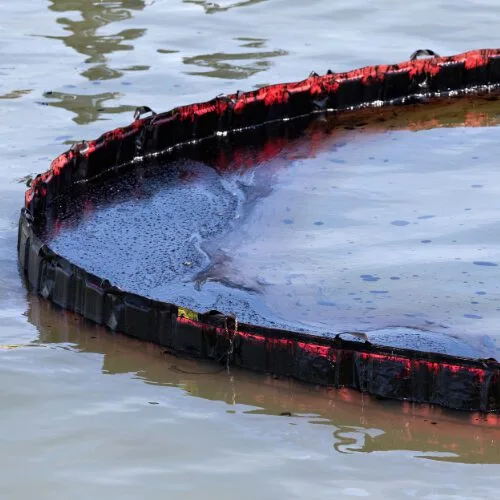
What should you do first in the event of an oil spill at sea?
In the event of an accident, the rule is: safety first, then the environment. The most important steps, in the correct order:
- Secure and report: Secure the danger area and immediately inform the relevant authorities – depending on the location, this may be the port authority, the water police, the fire service or the emergency number 112.
- Stop source: Where it is safe to do so, stop any further oil leakage.
- Limiting the spread: Set up oil booms to contain the oil slick.
- Record: Collect larger quantities of oil using skimmers or absorbent mats.
- Dealing with residual oil films: Residual oil films and hard-to-reach areas with FMO water bodies treat.
All measures are carried out in consultation with the incident command and the relevant authorities.
Where do oil booms and skimmers reach their limits?
Oil booms and skimmers are essential for containing and collecting large quantities of oil. However, in ports and along coastlines, there are many areas where they cannot reach or are barely effective:
- between rockfill, jetties and quay walls
- under jetties, pontoons and landing stages
- between boats and ships moored close together
- in heavily overgrown or shallow coastal areas
- in the case of thin, iridescent oil films that can hardly be collected by mechanical means
It is precisely here that, without further action, an oil slick often remains – with consequences for the water, the banks and living creatures.
How does FMO assist waterways in the event of an accident?
FMO Gewässer is a liquid, 100 % native oil absorbent that is sprayed undiluted directly onto the oil slick. Thanks to its liquid form, it can reach areas that oil booms and skimmers cannot access.
The included Biological surfactants break down the film of oil; special nutrients activate the naturally occurring Micro-organisms. These naturally break down the hydrocarbons within a few days. Further treatment or disposal of water containing FMO is not usually necessary – if required, this should be agreed with the relevant authority.
Are FMO waters suitable for use in ports and along the coast?
FMO Gewässer is classified as ‘not hazardous to water’ (nwg) under the AwSV and meets the criteria for the Non-HME classification – meaning it is considered not harmful to the marine environment. The constituents are biodegradable, non-toxic, non-persistent and non-bioaccumulative.
In any case, the following applies: any response to an incident is always coordinated with the incident command and the relevant authorities. You can read more about the classifications in our articles on Non-HME and to the Environmental and Water Protection.
How is FMO Gewässer used?
- Preparation: Shake the container well before use.
- How to use: Spray FMO undiluted over the entire surface of the oil film using a pressure sprayer, a garden sprayer or a hand-pump sprayer.
- Let it take effect: No further treatment is required. The oil film is broken down and decomposed by microorganisms.
What should be kept to hand in case of an emergency?
In the event of an accident, time is of the essence. Those who keep FMO on hand can treat residual oil films immediately, rather than having to wait for equipment. For a quick start, the FMO Waterways – Basic Starter Set Includes: 10 litres of FMO water and a Gloria Prima 5 PLUS pressure sprayer. Larger containers are available on request.
You can find advice on correct storage in the article Storage & Shelf life.
Who is FMO Gewässer suitable for?
FMO Gewässer is suitable for anyone who wants to remove oil films from water bodies need to deal with spills quickly without harming the environment – for example, port operators and marinas, shipyards, fire brigades and water rescue services, local authorities, operators of transhipment facilities and refuelling stations on the water, and environmental service providers.